
Greene County Multi-Day Arrest Reports
The Greene County Sheriff posts no fixed multi-day booking log. No 72-hour or seven-day version exists. The inmate search covers current custody only. For a recurring multi-day feed, one local source leads. The Porcupine Soup News police blotter is the strongest option. It publishes reports supplied by arresting agencies and public-information sources across Greene communities. Treat it as news coverage, not an official jail database.
Blotter stories can include people ticketed and released without an overnight stay. Others were remanded to Greene County Jail yet freed before the item ran. Want present custody? Then the Sheriff roster is the one to consult. Want a court outcome? The court record does. No press account can answer both questions for every case.
Read Greene County Arrest Blotters
Start with the date and the named agency. Blotter pages mix sources. A multi-day report may pull incidents from the Sheriff, State Police, and local departments, and it can blend arrest events with court appearances or release details. Keeping those fields separate keeps a news item from passing as a live custody answer.
- Open the recurring blotter and note the publication date before searching within the page for a name or Greene County town.
- Identify the arresting agency, incident date, and location stated in the entry. Do not infer an agency from the town alone.
- Read the charge, ticket, arraignment, remand, and court language as distinct facts. A remand means a court directed custody.
- Check the official Sheriff roster if the entry says the person went to Greene County Jail and current custody matters.
- Ask the originating agency for its report or the named court for a disposition when the news item does not resolve the question.
The Arrested Today path suits a fresh booking. This multi-day route is better for agency context and items posted after the fact. Neither can stand in for the other.
Note: The blotter’s date can differ from the arrest date, so search adjacent editions when an event falls near a weekend.
Greene County Arrest Report Fields
Porcupine Soup entries often run richer than the jail list. The mix varies by item. Because the arresting agency supplies the source facts, no field appears in every report.
| Report element | How to read it |
|---|---|
| Date, time, and place | The incident or arrest details stated by the source, which may predate publication. |
| Name, age, and locality | Identifiers in the report; verify carefully where people share names. |
| Arresting agency | The police body credited with the arrest or public information. |
| Charges and classification | Accusations and offense levels reported at that stage, not final findings. |
| Ticket or arraignment | Whether an appearance ticket or court appearance was reported. |
| Remand, court, or jail | The custody or court destination given at the time of the item. |
| Photo | No booking-photo gallery was observed on the blotter page reviewed for Greene County. |
A Sheriff booking record works differently. It may hold a public identifier and booked date. Current status, facility, descriptors, charges, bond fields, a photograph, and a VINE link may appear too. The news report explains why police acted. The roster shows who remains in the county jail system. Both can fall out of date once a court changes or drops a charge.
Compare like fields, not exact wording. A police release names an incident location. A jail record names a reporting agency and holding facility. The booking date may differ from the date printed on a later blotter item. That gap reflects each record's stage and purpose rather than an error. If two sources truly conflict, ask the originating agency to confirm its own record.
Porcupine Soup Arrest Coverage
The Porcupine Soup page shows Greene County blotter items.

Porcupine Soup says its facts come from arresting police agencies or public information sources. Corrections follow when details prove inaccurate or charges are dropped. Catskill and Coxsackie appear often. Its coverage also reaches Cairo, Athens, East Durham, Greenville, Windham, and other Greene locations as material arrives.
The outlet is still secondary. It is not run by the Greene County Sheriff. It creates no booking record. And it cannot promise a complete list of county arrests. Think context, not custody. Its value is the incident, agency, and court detail a live roster rarely shows.
Other Greene Arrest News Sources
The Greenville Pioneer example shows a weekly newspaper blotter mixing State Police and local entries. Weekly items can carry dates, towns, alleged charges, release details, and appearance information. That issue is historical. It does not prove current weekly access or a live booking window.
The Daily Mail has run its own Greene County Police Blotter format. Its NewsBank archive may require access. Newspaper files can preserve a narrative after a web post ages out. Neither source offers a free booking-photo gallery.
The New York State Police newsroom posts its own announcements, including Greene County incidents. It is statewide, not a county arrest log. NYSP does not archive daily blotter reports.
Note: News reports should be cited to their outlet and date; none replaces the originating police, jail, or court record.
Unofficial Greene Arrest Listings
Unofficial listings can still help. The RecentlyBooked Greene County listing uses a last-30-days frame drawn from public law-enforcement information. Treat names and dates there as leads needing confirmation.
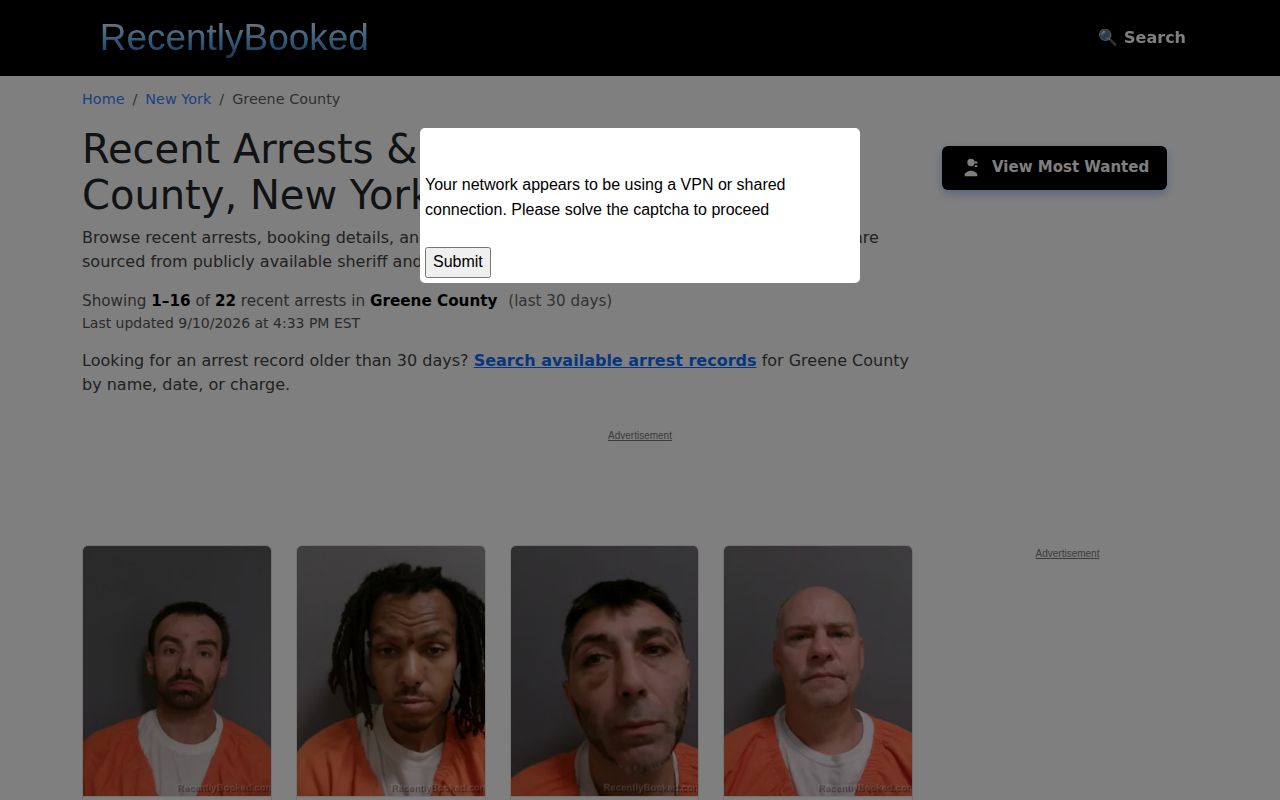
Third-party sites do publish arrest listings for Greene County. Those pages are not county records, and Greene government does not maintain them. Seeing a name there proves nothing about current custody.
The publisher says the listing refreshes more than once a day. But that is its own schedule. Its countywide grouping can mix arrests from several Greene agencies and towns. Check current custody through the Sheriff roster first. Then ask the named agency or court about the report behind the entry.
Greene Arrest Totals Are Not Logs
Greene County publishes no live, person-level arrest dashboard. What exists are annual and municipal activity reports with aggregate totals. The Sheriff's annual report covers past agency activity. Catskill's report is aggregate, and an older Cairo monthly report also summarizes activity. These documents show workload and trends well, but they cannot say who was arrested in the last few days.
Never merge an annual count with the Sheriff roster and call it a full arrest log. Each source answers a different question. A roster is a present custody snapshot. A blotter is selected incident reporting. An activity report is an aggregate summary covering its own dates.
- Roster
- A current list tied to county-jail custody.
- Blotter
- A dated set of agency-sourced news or incident entries.
- Activity report
- Totals grouped for a month or year, without a live person list.
- Disposition
- The court outcome that follows the initial arrest charge.
Greene Weekend Arrest Reporting
No official schedule sets a fixed posting time for Greene County arrest reports. That holds true after weekends and holidays. Porcupine Soup updates as agency information arrives. A report can appear days after the incident. State Police follow their own newsroom pattern. A local police agency may answer through records staff instead of a public blotter.
When timing is unclear, check several dates and keep custody separate from publication. A person can be released before any report posts. Another can stay held with no news entry at all. For current Greene County Jail custody, call the Sheriff. Contact the arresting agency for its own record.
Archive Greene County Arrest Reports
The Sheriff posts no multi-day backfile, and the live roster states no online retention period. For older arrest reports, send a narrow written request. Send it to the Sheriff or the police agency that created the record. Greene County's FOIL path routes written requests. Each agency decides what it keeps and may lawfully release.
The Greene County Records Center stores inactive county material but offers no public access. It directs requesters to the department that created or maintains the record. Ask that agency whether a file was transferred. Ask which retention series applies. New York schedules vary by record type. There is no fixed number of years that booking photos or arrest reports survive.
For printed history, the New York State Library Greene newspaper holdings list titles and microfilm. The Vedder Research Library also keeps local newspaper collections. An old blotter item may survive there. Still, old news cannot prove current custody. Court papers remain the better route to a case outcome.